Quinn
- My Role
- Product Designer
- Timeline
- May 2025 - July 2025 (3 months)
What is Quinn?
Quinn is an AI-native relationship intelligence platform that transforms how executives and business leaders manage their professional networks. The product bridges the gap between traditional CRM systems and intelligent relationship management.
Project overview
I worked with a founder (former chief of staff) to transform his idea for relationship management into a comprehensive product vision. My role was to translate stakeholder pain points into scalable product architecture, design progressive complexity framework, and validate market positioning through strategic design decisions.
From Spreadsheets to Strategic Intelligence
What This Enables
- Queryable relationship database – Ask business questions of your network in natural language
- Dynamic intelligence – Groups auto-update as relationships and context evolve
- Strategic prioritization – Q-scores adapt to specific goals (recruiting vs fundraising)
- Enterprise scale – Handle thousands of relationships with intelligent organization
The Problem: When Networks Become Liabilities
The Founder's Experience
The startup founder I worked with came from a chief of staff role where he'd witnessed this problem firsthand. His CEO maintained relationships with 30 million followers across platforms, an enormous business asset that was essentially unusable because it existed in fragmented silos.
The Core Problems
- Relationships scattered across LinkedIn, email, X, Instagram with no connection
- Critical opportunities missed during job changes, funding announcements, acquisitions
- No strategic querying – impossible to ask “Who do I know at Series A startups?”
- Manual maintenance that executives couldn't scale
An investor I spoke with illustrated the same pain: manually maintaining curated spreadsheets of SF-based designers, updating availability, companies, and seniority every few months. This static approach meant constantly outdated information and missed connection opportunities.
In relationship-driven business, your network is competitive advantage, but only if you can systematically leverage it.
From Concept to Vision
We began with the core insight that people needed queryable relationship graphs, not static contact databases. The question was: how do you enable executives to ask strategic questions of their network and get intelligent answers?
The Relationship Graph Concept
First Direction: Chief of Staff for Everyone
I explored a personal chief of staff approach, imagining mobile AI that could handle scheduling, reminders, and relationship management.
But when I presented this direction, the founder's feedback was clear and redirective: “Strictly for business use cases. This needs to solve a specific business intelligence problem.”
Brainstorming
With business focus clarified, I conducted a feature brainstorm. Everything from “Dead to Me” functionality to “Tinder Queue” relationship maintenance.
The Focus Question: What specifically enables people to query their relationship database, get intelligent answers, and take strategic business action?
Progressive Complexity Framework
- Search → Natural language queries creating temporary contact tables
- Groups → Save valuable queries as persistent, auto-updating collections
- Playbooks → Goal-oriented workflows optimizing relationships for specific outcomes
Each layer solved a core business problem while building toward sophistication without overwhelming users.
Design Execution: The Three Layers
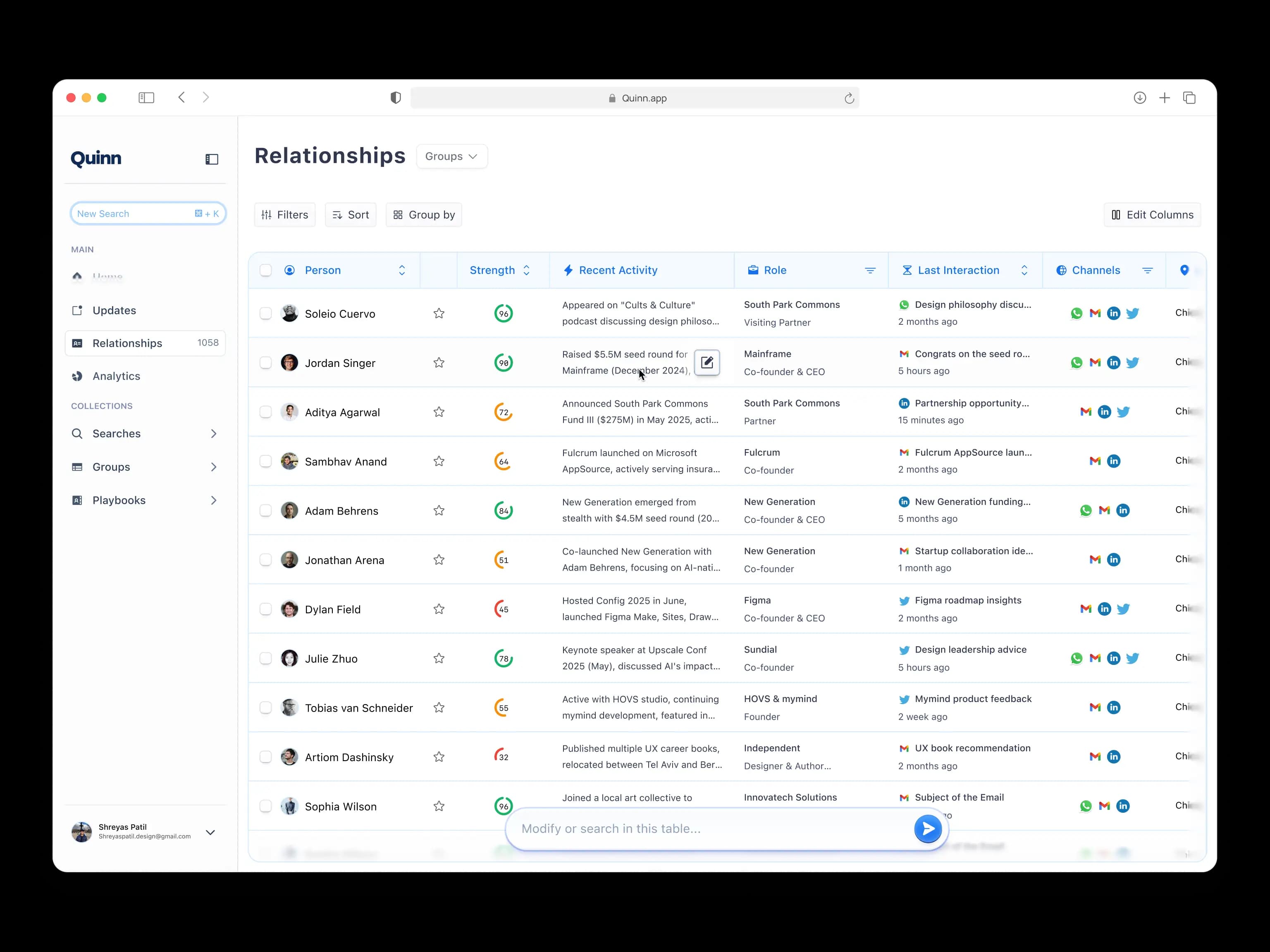
Layer 1: Queryable Relationships + Natural Language Intelligence
Strategic Design Decisions
- Table format over cards so executives can scan relationship depth quickly
- Color-coded strength indicators transform communication data into intuitive assessment
- Recent activity context keeps timing relevant for strategic outreach decisions
- Information density prioritizes business context over consumer simplification
AI Integration
Progressive complexity moves from simple name searches to sophisticated business questions like “founders who raised Series A in the last 6 months.” Bounded AI that feels predictable builds trust more than open-ended capabilities.
Layer 2: From Search to Strategic Collections
When executives run useful relationship queries, they want to reuse and share them. The “Save as a Group” function converts any filtered search into a persistent collection.
Groups grow and stay current through periodic AI research. The system discovers new people who match the criteria and adds them automatically - in this case, finding additional founders who raised Series A and adding their funding context.
Layer 3: Goal-Oriented Relationship Strategy
Daily relationship updates surface relevant contacts based on recent activity, with suggested actions that match your current priorities. “Send Email” for hiring, “Source Introductions” for partnerships.
Contextual Q-Scores
The same person gets different Q-scores based on your current business objective. Sambhav Anand shows “High Q-Score” for hiring contexts because Fulcrum recently posted engineering roles, but “Low Q-Score” for fundraising contexts since they just completed their Series A.
AI recommends relationship strategies based on context, timing, and business objectives.
Design Process: Learning from Platform Success
iTunes & Spotify Pattern Applied to Relationships
Both platforms started with comprehensive databases providing immediate utility, then progressively layered intelligence on top.
Quinn's Application
Each layer builds naturally on previous understanding without disrupting learned behaviors.
- Master relationship database → immediate contact utility
- Smart filtering → query capabilities
- Dynamic groups → persistent intelligence
- AI playbooks → strategic automation
What I Learned
Focus on the Golden Path
Rather than designing for every edge case, I learned the value of identifying the core 80% use case and making that experience exceptional. For Quinn, this meant prioritizing executive relationship querying over casual networking features. This discipline helped me avoid feature creep during the “Pantry” brainstorming phase.
Strong Opinions, Loosely Held
I realized the importance of designing with a strong, opinionated hypothesis. My initial “chief of staff for everyone” concept was strongly held but wrong. When founder feedback provided the “business only” constraint, I pivoted quickly. Clear direction creates momentum even when it needs to evolve.
Design for Coherent Systems that Evolve
I learned to think beyond individual features and design within a theory of the system. Quinn's search, groups, and scoring needed to work together cohesively while building toward future AI capabilities. The table interface became foundation for progressive complexity rather than just a contact list.